Chapter 7 · Grow guide
Soil and containers include transplanting information
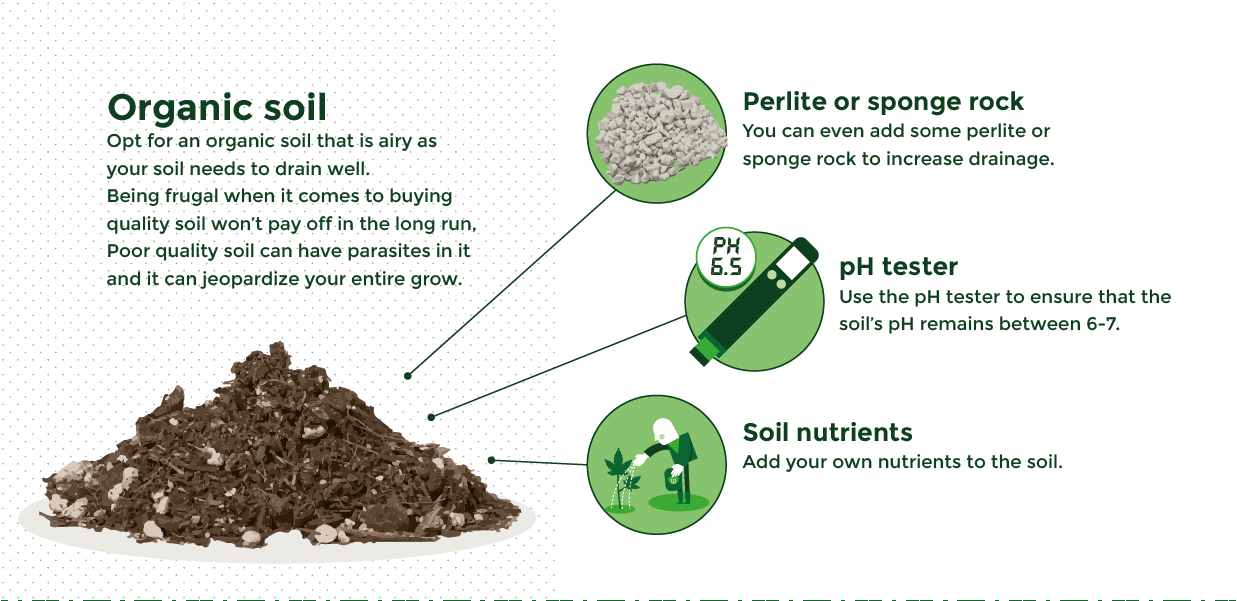
Your growing medium is another important part of your setup. Opt for organic soil that is airy as your soil needs to drain well. You can even add some perlite or sponge rock to increase drainage.
Don’t use one full of nutrients as your seedling will need different nutrients than when it is an adult. Instead, you will need to add your own nutrients to the soil. A fertilizer with the right N-P-K ratio provides the nutrients your cannabis plant needs, and that ratio changes at every stage — see nutrients needed for each life phase for the numbers. Use the pH tester to keep the soil’s pH between 6.0 and 7.0 (source 1).
Start your plant in a small pot
It is important to transplant your marijuana plant from a small pot when it is a seedling to a larger pot as it grows. If you start off your seedling in a large pot then the tiny roots will be sitting in a large amount of soil not being able to absorb all the moisture. This is a problem as it can lead to root rot. When you are looking into the size of containers to plant your marijuana, take into consideration that the biggest limitation for its overall development is root expansion. In order, for your plant to reach its full potential its roots will need to be able to fully expand.
Change pot sizes with the plant’s life stage
Once your seeds have germinated then you can put them in a small container. After the seedling has developed 4-5 sets of leaves then you can transplant them to a larger container. It’s during the last 2 weeks of the vegetative phase that most growers will transplant their marijuana plant into its final container. During the flowering stage, your plant will grow exponentially larger and if it becomes root-bound it will have a direct negative impact on your yield. If space permits it, you should opt for a 5-gallon sized container to ensure that your flowering plant has enough space to flourish.
Rootbound signs
You should keep an eye on your cannabis plant to make sure that it does not outgrow its pot and become root-bound during any stage of its life. Typical signs of a marijuana plant being root bound are:
- Red stems
- Stunted growth
- Nutrient sensitivity
- Stretching
- Wilting, as if it looks underwatered
- Small and lower bud production
- Appears to need watering too often
By transplanting your plant from a small container to eventually a large one, you are giving it the best opportunity to grow to its full potential. The roots will be able to support a large yield if they are given the environment to fully develop.