Bud rot on marijuana plants: Causes & how to deal with it
How to stop & prevent bud rot on marijuana plants? Our expert helps you get rid of it. What does it look like? Identifying botrytis Cinerea.
Contents
Bud rot is gray mold, caused by the fungus Botrytis cinerea, and it is one of the most common ways a cannabis harvest is lost late in flower. It usually starts deep inside a dense bud, where you cannot see it, and it spreads fast once humidity stays high. If you catch it early you can often save the rest of the plant. If you miss it, it can take the whole crop.
The short version: look for buds that turn brown or gray from the inside, cut out the affected part with a wide margin, bag it, and bring the humidity down. Then work on the cause, which is almost always damp air that does not move.
Below you will find how to recognise bud rot, what makes it start, what to do when you find it, how to prevent it, and the questions growers ask us most.
How do I identify bud rot?
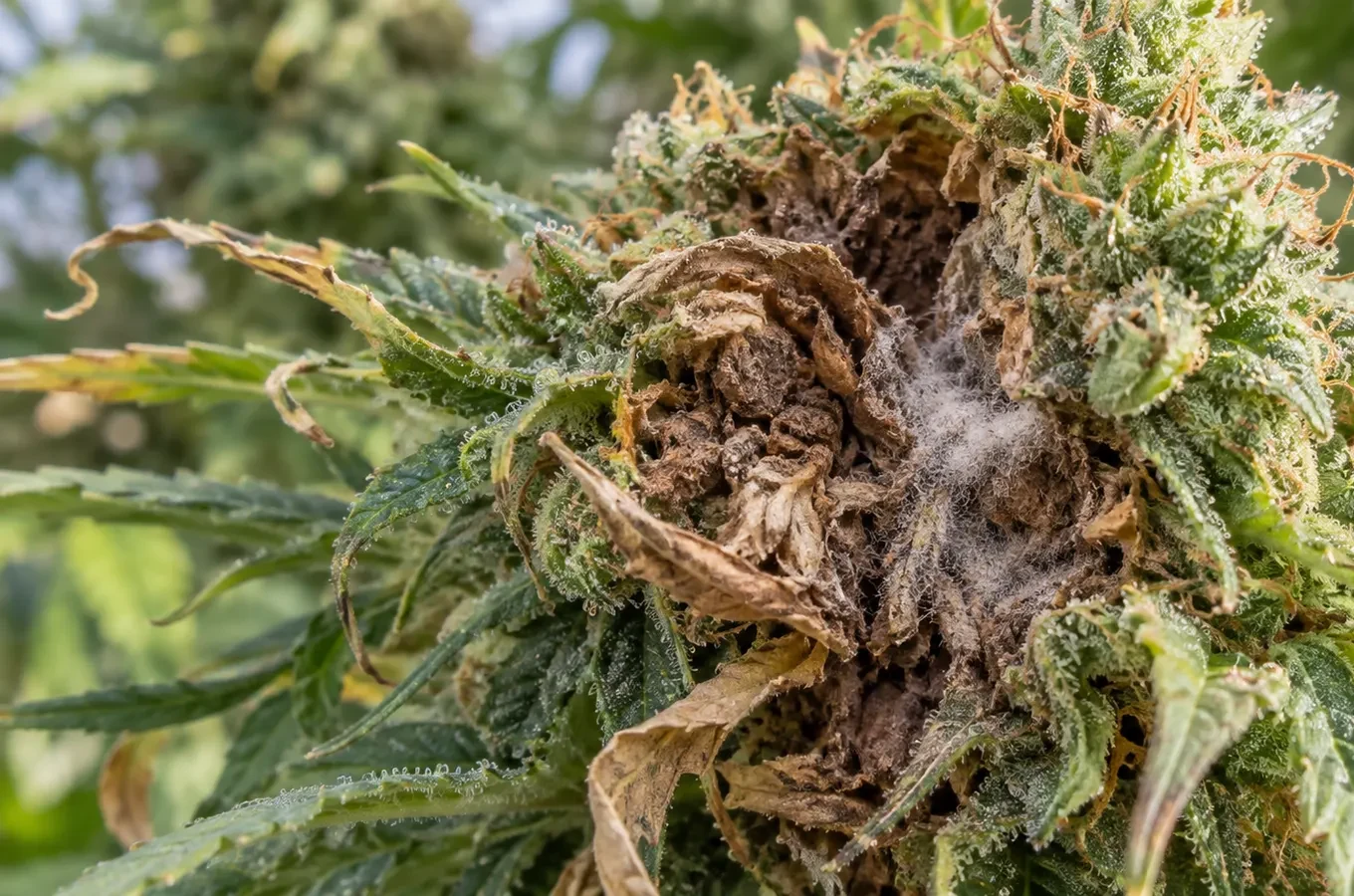
Research on cannabis grown in indoor rooms and greenhouses describes Botrytis bud rot as brown discoloration of the flower, blighting of the bracts and leaves, and decay of the tissue (Punja et al., 2019). In their lab test, infected tissue grew a grayish-brown mold within 48 hours in a closed bag. That matches what growers see: gray, fuzzy patches or a mushy, brown core.
The outside of the bud can still look fine while the middle has already rotted.
Signs to check for:
- A single leaf or sugar leaf that turns yellow or brown and dies while the rest of the bud is still green.
- A bud that feels soft or wet in the middle when you squeeze it gently.
- Gray or white fuzz when you break a bud open.
- A musty smell that was not there before.
Check between the leaves and inside the biggest buds every day in late flower. If you find one infected bud, look at the buds around it. Spores travel through the air, on water and on your hands and clothes, so also look at the plants next to it.
Bud rot, powdery mildew or just dying leaves?
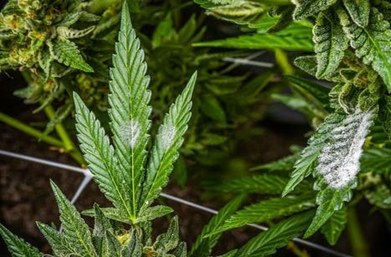
Powdery mildew is a white, flour-like coating on the surface of the leaves. Bud rot is darker (gray to brown), and it rots the bud from the inside. Normal late-flower leaf fade starts at the lower leaves and has no fuzz or mushy tissue. If you are not sure, break open the bud. A brown or gray, soft core is bud rot.
What causes bud rot?
Botrytis needs damp conditions. The University of California's integrated pest management program says gray mold infects plants after 6 or more hours of continuous wetness, or when relative humidity stays above about 90% for that long, and that it is most troublesome in high humidity with moderate temperatures of 70 to 77°F (about 21 to 25°C). It is also active over a wider temperature range, so a cooler room is not a guarantee. The same source notes that once dead or weakened tissue is infected, the fungus can move into the healthy tissue next to it (UC IPM, Botrytis Blight, or Gray Mold).
In practice, these are the things that set it up:
- High humidity in flower. Buds are dense and hold water. Humidity that jumps up at night, when the temperature drops, can leave moisture on the flowers.
- Little air movement. Air that sits still inside the canopy keeps the buds wet for longer.
- Dense buds and a thick canopy. Big, tight colas trap moisture inside, which is why bud rot often shows up in the best-looking bud on the plant.
- Crowded plants. Plants that touch each other have less airflow between them, and the infection passes from one to the next.
- Wet buds. Rain or dew outdoors, and spraying or heavy watering indoors.
- Spores already in the room. Punja et al. (2019) describe spread of spores through the air and through cuttings as ways it gets into a grow.
In our experience, and in the customer feedback we read, it is rarely about one plant. One grower lost the tops of every plant of one strain in a packed room, while other strains in the same room stayed clean. Another grower saw the same strain come through fine outdoors. That points to plant density and environment more than to the plant alone. Genetics still matter. In a study of greenhouse cannabis, strains with more leaves among the flowers had higher mold levels, and so did flowers with a warmer, more humid microclimate inside the bud (Punja et al., 2023). No strain is immune.
How do I treat bud rot?
You cannot cure a bud that has bud rot. Rot is dead tissue, and it does not grow back. What you can do is stop it from spreading.
- Find every infected bud. Check each plant, including the ones that look healthy.
- Wear gloves. Cut the infected bud off with clean scissors, taking a few centimetres of healthy-looking tissue below it.
- Put the cut material in a closed bag or container right away, and carry it out of the room. Shaking an infected bud over the other plants sends spores everywhere.
- Clean the scissors with isopropyl alcohol after every cut, or use a second pair.
- Lower the humidity and increase airflow in the room straight away.
- Check again the next day and every day after that. Bud rot can keep going from a spot you did not see.
If many buds on a plant are affected, or if the stem is infected, take the whole plant out. If the plant is close to harvest, it is better to harvest early than to lose the rest of the room. Do not keep or smoke any moldy bud. UC IPM's gray mold guidance also says to remove and dispose of old blossoms, declining plant tissue and debris, so clean up fallen leaves and trimmings too.
Should I spray something on the buds?
We say no. Jan's advice is not to spray flowering buds at all. Extra water on the flowers works against you, and anything you spray on the buds ends up in what you smoke. UC IPM describes fungicides for gray mold as preventative only and generally not very effective once conditions favour the fungus. A 2021 review of cannabis diseases adds that fungicides are not currently registered for use on cannabis in North America, so there are no published data on how well they work (Punja, 2021). Changing the environment works better than any spray.
Outdoor grows
Because of the unique challenges of growing outdoors, rain and dew can leave the flowers wet for days, and you cannot control the humidity. If a wet spell is on the way in autumn, check the thickest colas every day, remove leaves that block airflow around them, and think about harvesting the most at-risk buds early. A spot with morning sun helps dew dry off sooner.
How to prevent bud rot
Prevention is a lot easier than treatment, because it is about the room and not about the plant.
Keep humidity down in flower
Jan's rule is to keep the humidity under 50% during flowering. Use a hygrometer at canopy height, not by the door. A dehumidifier is worth the money in a small tent in a damp climate. Read our guide to humidity for indoor cannabis for target numbers per stage, and the VPD guide if you want to go further.
Keep the air moving
Run an oscillating fan so that air moves through the canopy, not just over it, and use an extractor fan to replace humid air with drier air. Check that the leaves in the middle of the plant move a little. If they do not, the buds are probably sitting in damp air.
Give the plants space and thin the canopy
Plants should not touch. Remove a few large fan leaves that block airflow near the buds, and trim away small lower growth that will not form good flowers anyway. UC IPM advises spacing plants and pruning the canopy for the same reason. Do not overdo it: strip a plant bare and you stress it.
Handle the plants gently
Bruised or broken plant tissue is an easy way in for fungus. Jan says to avoid bruising the buds. Punja et al. (2019) also report that entry through wounds on roots, stems and bud tissue helps pathogens get established. Be careful when you move, tie down or trim plants.
Check every day, and keep the room clean
Look at the plants every day in late flower, and remove dead leaves from the floor and the pots. A grow room that is cleaned before every run has fewer spores to begin with. Washing your hands, and changing clothes when you come in from other plants or from outdoors, helps too.
Pick a plant that suits your room
Dense, heavy-budding plants carry the highest risk in damp rooms.Some growers call certain varieties mold-resistant, but that is their experience, not a guarantee.
What about bud rot after harvest?
Bud rot can show up in the jar too. Punja et al. (2019) note that infection of flowers during production can lead to significant losses in storage after harvest. Do not jar buds that still feel damp in the stem, and check your jars regularly during the first weeks of curing. If you find a bud with fuzz or a musty smell, take it out right away.
Frequently asked questions
How fast does bud rot spread?
It depends on the conditions. In a warm, damp room with dense buds it can move from one bud to several quickly. In dry, moving air it often stays where it started. This is why daily checks in late flower matter.
Can I save a bud that has bud rot?
No. Cut out the infected part with some healthy tissue around it. The rest of the plant can often be saved if you act early and fix the humidity.
Is it safe to smoke moldy weed?
We do not recommend it. Do not use any bud that has gray or white fuzz, a musty smell or a rotten core. Cutting off the visible mold does not remove the fungus you cannot see.
Can I use a spray or fungicide on flowering plants?
We advise against it. Wet buds help the fungus, and a spray stays on the flowers you will use. Focus on humidity, airflow and spacing instead.
What humidity prevents bud rot?
Jan keeps it under 50% in flower. UC IPM shows that gray mold needs long periods of high humidity or wet surfaces, so the aim is to avoid damp spells, especially at night when the temperature drops.
Can bud rot spread to other plants?
Yes. The spores travel through the air, on water, and on hands, tools and clothes. Bag infected material before you carry it out of the room, and clean your tools.
Does bud rot affect autoflowers too?
Yes. Any cannabis plant with dense buds can get it. Autoflowers finish faster, but they are not protected if the room is damp.
Is bud rot the same as root rot?
No. Bud rot is a fungus on the flowers. Root rot affects the roots, usually from overwatering or poor drainage. We have a separate guide on how to avoid root rot.
Sources: Punja ZK, Collyer D, Scott C, Lung S, Holmes J, Sutton D (2019). Pathogens and molds affecting production and quality of Cannabis sativa L. Frontiers in Plant Science 10:1120. Punja et al. (2021), Emerging diseases of Cannabis sativa and sustainable management Pest Management Science 77:3857-3870. Punja ZK, Ni L, Lung S, Buirs L (2023). Total yeast and mold levels in high THC-containing cannabis inflorescences are influenced by genotype, environment, and pre- and post-harvest handling practices. Frontiers in Microbiology 14. UC Statewide IPM Program, Botrytis Blight, or Gray Mold.
Bud Rot is far easier to prevent than to treat, so give your plants dry, moving air and check them often. Happy Growing!