Chapter 3 · Grow guide
The life cycle of the cannabis plant
Knowing how to grow marijuana, begins with understanding the life cycle of this plant. The life cycle of a marijuana plant consists of incredible changes that allow it to go from a small seedling to a large bushy plant with flowers that you can smoke. When you begin to grow it is important to know the stages of a marijuana plant so that you will know what to expect and be able to notice if something is not right. Knowing at which stage your plant is in will allow you to give it the proper nutrients, light, and water so that you end up with a flourishing plant. The four main stages that a marijuana plant goes through from seed until harvest time include: germination, seedling, vegetative, and flowering.
a. Germination
The cannabis plant life cycle begins with high-quality seeds. The seed of the marijuana plant is dormant and needs water to bring it to life. This process is called germination and can start anywhere from 24 hours and can take up to 7 days and sometimes even more. The wet seed will then sprout its taproot and can then be placed in a growing medium. The taproot will grow downward into the growing medium as the stem grows upwards and then two cotyledon leaves will grow from the stem. The cotyledon leaves will take in the sunlight allowing the roots to develop along with the first fan leaves. Now your plant is considered a seedling.
b. Seedling stage
Specific traits define a seedling plant. It must have developed a stable root system and true leaves, which means it has leaves that look like the iconic marijuana leaves we can all recognize. During this stage, a seedling will grow anywhere from 4 to 8 leaves. A cannabis plant can stay in the seedling stage for a broad range of time but normally around 3 weeks. This all depends on environmental factors like the soil, the amount of water the seed gets, the quality and amount of light, and the specific strain that is being cultivated. A healthy seedling will be short with dense vegetation, and it should not seem to be reaching for sunlight. The leaves should look bright and green. During this phase, the seedling is particularly vulnerable to mold and diseases. The seedling’s environment should be kept clean and without excess moisture. Avoid overwatering the seedling as its roots are still small and don’t require very much water
c. Vegetative stage
The next stage in the marijuana plant life cycle is the vegetative stage; this is when the marijuana plant really begins to take off. In this stage, the plant starts to show big jagged leaves and produces much more foliage since it is now able to absorb and process much more nutrients and carbon dioxide.
The growth of the marijuana plant will mainly depend upon the rate, that the leaves can gather sunlight and undergo photosynthesis. This is why during the vegetative stage indoor plants are commonly given about 18 hours of light and 6 hours of darkness (source 6). It’s at this stage that you can begin topping and training the marijuana plants.
Your plant will need lots of nutrients in this stage such as higher levels of nitrogen. You will also need to give it more water and not just close to the stalk but around the plant as well so that its growing roots get water too. It is during this stage that it is possible to determine if the plant is male or female based on the pre-flower located at the nodes. As soon as you are able to determine the gender of the plant you will need to separate the males so they don’t pollinate the flowering female plants.
The pre-flowers that you are looking for are found at the “V” where the plant’s stems come together at the main stalk. You may need to check different locations on the plant since the pre-flowers show up at various places, especially closer to the top of the plant. The male plant will have very small spade-shaped (spade-liken a deck of cards) pre-flowers. When the plant matures, these spade-shaped preflowers will become pollen sacs and look like a bunch of grapes. The pre-flowers on a female plant will not look like a spade, instead, they will be long and narrow. Eventually, a white pistil will begin to stick out from the top.
d. Flowering stage
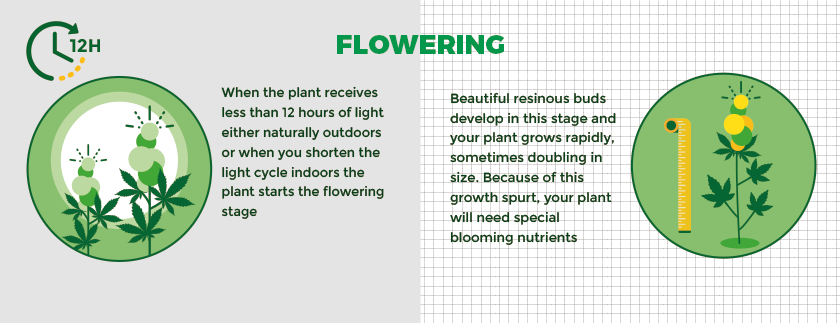
The flowering stage is the final stage of the marijuana plant. It’s the one every grower anticipates the most. When the days shorten naturally outdoors, or when you cut the light cycle indoors to about 12 hours of light and 12 hours of darkness, a photoperiod plant starts the flowering stage. In one study, the best flowering results fell between 12 and 13 hours of light, depending on the cultivar (source 10). Autoflowering plants do not need this switch: they start flowering with age. Beautiful resinous buds develop in this stage and your plant grows rapidly, sometimes doubling in size. Because of this growth spurt, your plant will need special blooming nutrients and you may need to use a stake or trellis to give your plant support as it develops buds. The trichomes on the buds will let you know when the marijuana plant has reached full maturation you can begin the harvest.
Every stage of the marijuana plant has its own unique characteristics. Knowing the stages will allow you to give your plant the right nutrients along with an environment that will allow it to flourish.