Chapter 10 · Grow guide
Temperature, Humidity, and Ventilation
Growing potent cannabis plants incorporates mastering the art of having these inseparable factors – temperatures, humidity, and ventilation. However, some marijuana growers tend to overlook the latter two and focus on the former only. In this write-up, we are going to break down each of these down.
Temperature
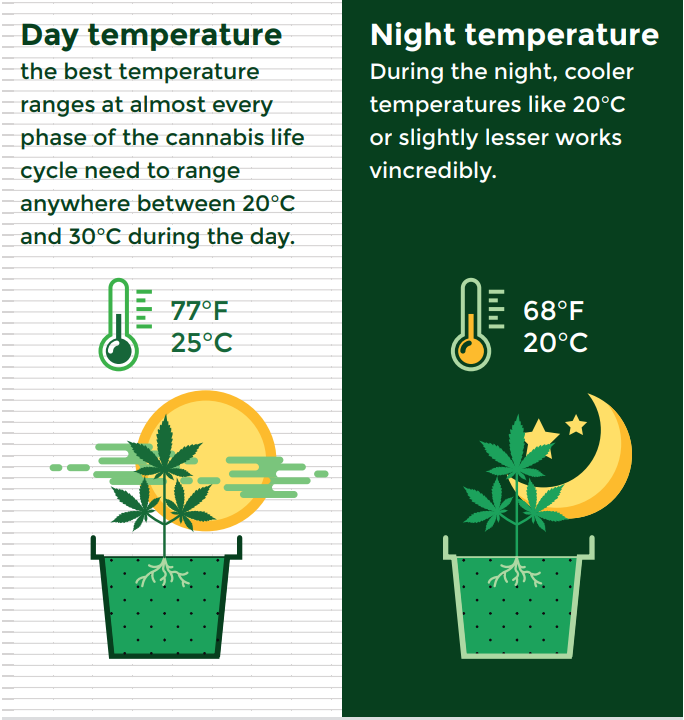
Cannabis plants tend to be choosy on the optimum room growth temperatures. Depending on the cannabis strains planted, the stage-by-stage targets are listed in the table below. As a general guide, a greenhouse review recommends 25-28 °C in the vegetative stage and 23-28 °C in flowering (source 3).
At night, keep the room a few degrees cooler than during the day. One indoor trial ran 26 °C by day and 22 °C by night (source 5).
But you may be wondering, “why do temperatures matter this high in these plants?” Well, cold temperatures tend to slow down cannabis plant growth. When they grow insanely low, the plants may as well end up withering. On the contrary, high temperatures can disturb bud formation and lower the yield, especially in the flowering phase: a study cited in source 4 reported that total cannabinoid yield fell sharply when day and night temperatures rose from 25/21 °C to 31/27 °C. The roots may as well end up rotting due to the increase in water transpiration in the soil. The main emphasis here is on ensuring that you keep the temperatures as optimal as possible. They should be relatively higher during the day and lower at night. When you interchange between these two, you may end up having changed leaf and bud color.
Humidity
Humidity is a primal factor in the later outcome of the weed yields. If you plant your strains indoors, the outdoor humidity plays a significant role in what the humidity levels show indoors. In the four phases of the life cycle of the cannabis plant, it can’t be wrong to say that humidity plays a significant role in the four. Now that different strains have different specs and requirements, it is worth familiarizing oneself with specific issues.
Controlling humidity levels
High relative humidity (RH) invites mildew and mold, and it also slows down flowering. In a controlled trial, plants grown at 78-98% RH produced 71% less flower biomass and flowered later than plants grown at 37-58% RH (source 4). Use a hygrometer to measure it, and use a humidifier or dehumidifier to stay in range. A greenhouse review gives 65-75% RH for the vegetative stage and 50-70% for flowering (source 3). We recommend working toward the lower end of the flowering range, around 40-50% RH, in the last weeks of flowering, when dense buds are most at risk from mold; the low-humidity plants in source 4 stayed within 37-58% RH. Too dry is also a problem: very low humidity can cause the plant to lose water faster than its roots can supply it.
Target ranges by growth stage
One consistent set of targets for an indoor grow. Where a figure comes from a published source, the source number is shown; “our recommendation” marks a judgement of ours that has no direct trial behind it.
- Seedling (roughly the first 3 weeks): 25-28 °C, 65-75% RH, 18 hours of light. The seedling uses the same ranges as the vegetative stage, which we apply from the review in source 3 as a starting point (our recommendation). No fertilizer yet; see the chapter on nutrients.
- Vegetative: 25-28 °C and 65-75% RH (source 3), 18 hours of light and 6 hours of darkness (source 6). Soil pH 6.0-7.0; hydroponics, coco or other soilless media pH 5.5-6.5. Published trials fed young plants a mild nutrient solution of about 1.0 mS/cm EC at pH 6.0 (source 8).
- Early flowering: 23-28 °C and 50-70% RH (source 3), 12 hours of light and 12 hours of darkness (source 10).
- Late flowering: 23-28 °C, with RH toward 40-50% to protect dense buds from mold (our recommendation, based on source 4).
- Drying: 15-20 °C and 50-60% RH, in the dark with gentle air movement and no fan blowing straight on the buds (source 9).
- Curing: around 18 °C and 60% RH; one study cited in source 9 cured for 2 weeks and opened the container after 6 hours.
Ventilation
Ventilation and humidity go in handy in the cannabis context. For instance, increasing the airflow where the plants get planted aids in lowering humidity levels. Conversely, reducing airflow helps in upping humidity levels. Ventilation is among the best techniques to employ when faced with pathogens. Well, cannabis plants, just like many other plants, require fresh air every additional time. At each phase, these plants need super air exchange. Under most circumstances, cannabis plants are grown in outdoor settings rarely require artificial forms of air circulation as air and wind tend to circulate freely. It’s an undeniable fact that ventilation aids in controlling odor in cannabis tents and greenhouses.
Indoor ventilation
You undoubtedly require certain things if at all, you would like adequately ventilated cannabis plants. Such include duct tape, an intake fan, and an exhaust fan. An intake fan works fantastically in ensuring that air gets exchanged within a minute and two. You ought to at least ensure that this fan gets placed in the bottom of the tent and connect it to an open place with fresh air. The core function of duct tape is ensuring that the duct system gets held in place to prevent any sorts of mishaps in the quest to ensure efficient flow of air in and outside of the growing tent or greenhouse. An exhaust fan helps in ousting contaminated air. It also aids in ensuring that the plants won’t suffer from windburn arising from excessive air allowed by the intake fan.
In Summary
We ought to mention that not only does temperature, humidity, and ventilation have a fantastic role in growing cannabis, all these factors end up causing the overall bud potency after harvesting. That said it’s crucial to ensure that you subject the plants to the optimal rates given above on this guide. That way, you rest assured of plants free from molds and overdrying, which in the long run translates to highly potent yields